The Story
Hamsa Damayanti
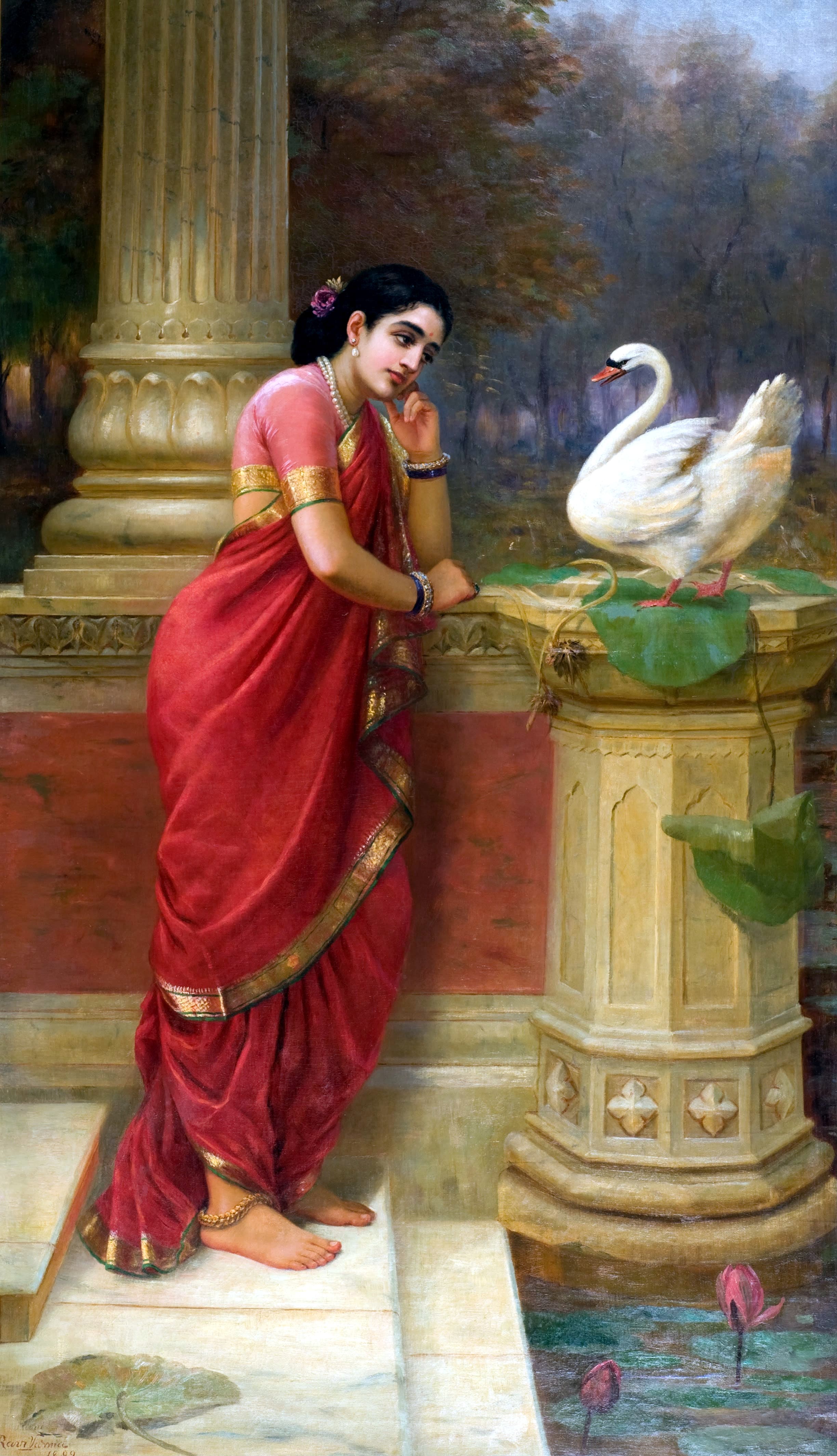
The story of Damayanti and Nala from the Mahabharata is one of the great love narratives of Sanskrit literature: a princess falls in love with a king she has never met after a magical swan — a hamsa — carries messages of love between them across the distance that separates them. Ravi Varma chose the moment of intimate communication between Damayanti and the divine messenger bird, a subject that allowed him to combine his extraordinary gift for painting women in silk and jewels with a genuinely touching narrative of longing and hope.
The painting demonstrates every strength of Varma's mature style. Damayanti's drapery — heavy silk rendered with the same careful fidelity to fabric that the Dutch masters brought to their cloths — falls in weighted folds around her reclining figure. The swan is painted with a naturalist's attention to plumage and posture. The jewels at her throat and wrists catch the light individually, each stone a small miracle of observation. And yet none of this technical display overwhelms the emotional core: a beautiful young woman, leaning close to a magical bird, hanging on every word it carries from the man she loves.
Varma later reproduced this composition as an oleograph, and it entered the popular visual imagination of India alongside his other mythological subjects. The hamsa carrying messages became a shorthand for romantic longing in popular culture — appearing in film, advertising, and decorative art throughout the twentieth century. The painting is a reminder that Varma's real achievement was not merely technical mastery but the ability to make ancient stories feel urgently, personally alive.
Deep Dive
Scholarly Analysis
Composition & Technique
Raja Ravi Varma's Hamsa Damayanti (1899) is among his most technically accomplished works, demonstrating the full range of his European academic training applied to Indian mythological subject matter. The scene depicts Damayanti receiving the swan (hamsa) sent by Nala, through which the two communicate their love — a pivotal episode from the Mahabharata's Nala-Damayanti tale. Ravi Varma renders the swan with careful naturalistic attention to its feathering, while Damayanti is portrayed in the three-quarter pose typical of his heroines — the same pose that derives from European academic portraiture but here inflected with the specific emotional register of bhakti longing. The jungle setting is rendered with lush tropical foliage that no European academic painter could have produced — it is unmistakably the landscape of the Kerala in which Ravi Varma spent much of his life.
“Ravi Varma understood that the literary and visual imagination of India had been separated by centuries of different traditions, and he set out to reunite them — to show what Kalidasa and Vyasa actually looked like.”
Historical Context
The painting was made at a moment when Ravi Varma's fame was at its peak — his lithographic press was distributing prints of his mythological scenes across the subcontinent, creating a mass visual culture of Hindu iconography. The Nala-Damayanti story is one of the most celebrated love narratives of the Sanskrit tradition, embedded in the Mahabharata and retold in Kalidasa's verse. It is a story about the choice between divine and human love, about constancy and exile and reunion. Ravi Varma's selection of the swan-messenger episode — arguably the most romantically poignant moment in the narrative — was artistically astute: it allowed him to depict yearning rather than action, which was his greatest strength.
“The love stories of Sanskrit literature are not romances in the European sense — they are philosophical arguments about the relationship between the self and the beloved, between desire and devotion. Ravi Varma was the first to make them visible.”
Cultural Significance
The Hamsa Damayanti series — Ravi Varma made multiple versions — along with his other mythological scenes shaped the visual imagination of Indian popular culture in ways that continue into the present. His lithographic prints of scenes from the Mahabharata and Ramayana were the first mass-produced visual representations of these stories, and their influence on subsequent illustration, cinema, and television adaptation of Hindu epics is incalculable. The swan as messenger of love — a motif with deep roots in Indian and Greek classical literature — achieves in Ravi Varma's hands a visual definitiveness it had previously lacked.
“What the printing press did for the word, Ravi Varma's lithographic press did for the Indian visual imagination. He democratised the sacred image.”
Critical Reception
Like all Ravi Varma's major works, Hamsa Damayanti was praised in its time, critiqued in the early twentieth century as insufficiently Indian by the Bengal School, and reassessed positively in postcolonial scholarship. The specific work has attracted attention from scholars of Sanskrit literature as well as art historians, given the richness of the textual tradition it engages. It is held in a private collection and has been exhibited internationally as part of surveys of Indian art at the Smithsonian Institution and other major venues.
“The debate about whether Ravi Varma was Indian or European misses the point entirely. He was both, in ways that were historically necessary and aesthetically fertile. Hamsa Damayanti could not have been made by a purely Indian or a purely European painter.”
About the Artist
The Artist
Raja Ravi Varma
Indian · Modern Indian Art
Raja Ravi Varma (1848–1906) was the first Indian painter to master European academic oil-painting techniques and apply them to scenes drawn from Hindu mythology and Indian everyday life, creating a new visual language that resonated across the subcontinent. His large-format canvases brought gods, goddesses, and epic heroes to life with a naturalistic warmth that made them immediately accessible to ordinary Indians, and his oleograph prints disseminated these images into millions of homes. Often called the Father of Modern Indian Art, his legacy extends from the walls of palaces to the shrines of humble households.
Own a Piece of This Masterpiece
Bring Hamsa Damayanti Into Your World
Museum-quality reproductions and artisan objects inspired by this masterwork — scarves, mugs, prints, and more. Crafted with the care the original deserves.