The Story
The Milkmaid
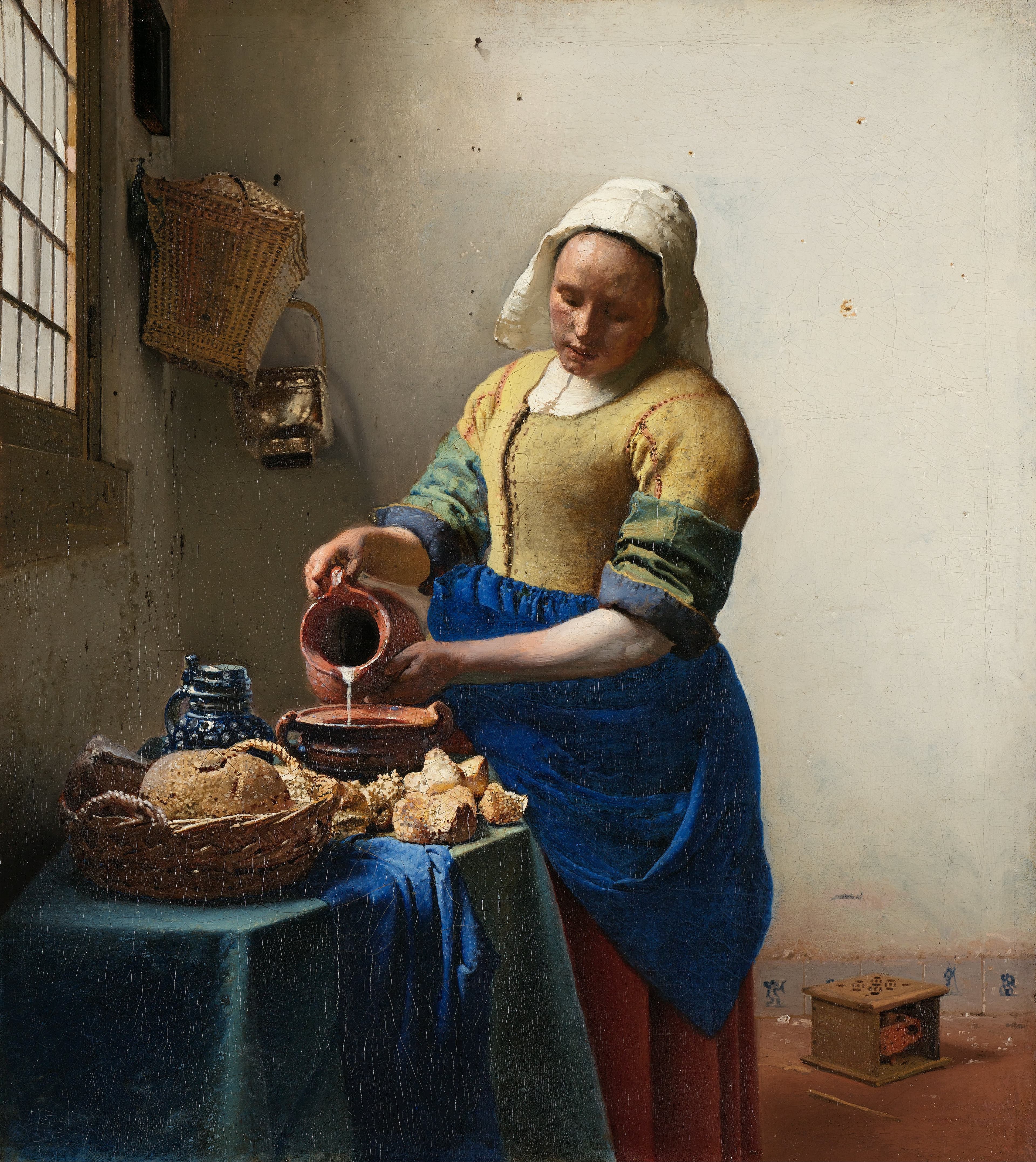
A kitchen maid pours milk. That is all. And yet Vermeer, painting in Delft around 1658, transformed this utterly unremarkable domestic act into one of the most luminous, intensely observed paintings in the Western tradition. The woman — solidly built, sleeves rolled up, entirely absorbed in her task — stands by a window as morning light falls across her yellow bodice, her white cap, the blue cloth on the table, and the thin arc of milk descending from the jug into the earthenware bowl below. Everything in the room radiates with the quality of that light.
Vermeers interiors were quiet acts of close looking at a world that most artists of his period considered too humble to paint. Where his contemporaries celebrated history painting, mythology, and portraiture of the wealthy, Vermeer found the sublime in servant girls and linen tablecloths and bread. His genius was the patience and precision of his observation: the dimpled skin of the bread crust in the lower right of The Milkmaid has been noted by food historians as one of the most accurate depictions of seventeenth-century Dutch bread on record. He painted what was in front of him with a fidelity that approaches reverence.
The Rijksmuseum has called The Milkmaid the one Vermeer they would never loan to another institution. When it traveled to New York for a brief exhibition in 2009, it was the first time it had left Amsterdam in a century. Dutch viewers reportedly wept on the steps of the Rijksmuseum during its absence, which is perhaps the most eloquent testimony to what a great painting means to the people who grew up with it: not an object in a museum but a presence in a life.
About the Artist
The Artist
Johannes Vermeer
Dutch · Dutch Golden Age
Johannes Vermeer (1632–1675) was a Dutch Baroque master celebrated for his incomparable command of light and his quiet, intimate scenes of everyday domestic life. Working almost exclusively in Delft, he produced a small but exquisite body of about 34 to 36 known paintings, each revealing an almost photographic precision achieved through his legendary use of the camera obscura. His works glow with an inner radiance that continues to mesmerise viewers more than three and a half centuries after his death.
Own a Piece of This Masterpiece
Bring The Milkmaid Into Your World
Museum-quality reproductions and artisan objects inspired by this masterwork — scarves, mugs, prints, and more. Crafted with the care the original deserves.