Girl with a Pearl Earring Art Print
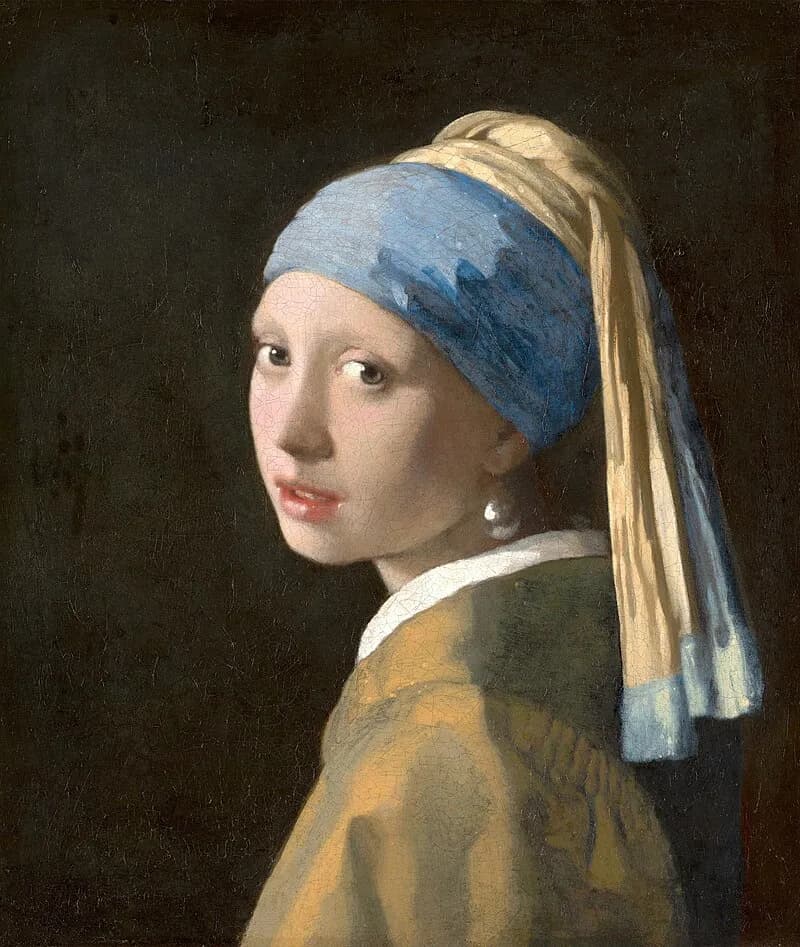
Based on “Girl with a Pearl Earring” (c. 1665), Mauritshuis, The Hague
Vermeer's most enigmatic portrait, reproduced with museum archival standards for your home.
Quantity
She turns. That is the whole story, and yet it is inexhaustible. Vermeer's Girl with a Pearl Earring, painted around 1665, shows a young woman — her identity still unknown after three and a half centuries of scholarship — caught in the act of turning toward the viewer from a plain dark background. Her parted lips, slightly moist, suggest she is about to speak. Her dark eyes hold yours with an expression that is at once direct and unknowable. And at her left ear hangs a single large drop of luminous pearl, painted with the same extraordinary command of light that Vermeer brought to every surface he ever touched. The work is technically a tronie — a Dutch term for a study of a face or head that is not a formal portrait but rather an exploration of expression, costume, or character type. Vermeer was a master of the form, but this particular tronie transcends the category entirely. The simple blue-and-yellow turban, exotic for a Dutch girl of the period, gives her a timeless, placeless quality; she belongs to no specific century. Art historians have proposed she may be his eldest daughter Maria, or a model hired from the streets of Delft, or a figure drawn from imagination. The mystery is part of the painting's power. Tracey Chevalier's 1999 novel of the same name and the subsequent film with Scarlett Johansson introduced her to an entirely new generation, and the Mauritshuis in The Hague now draws hundreds of thousands of visitors each year specifically to stand before this small canvas, roughly the size of an A3 sheet, and feel the uncanny sensation that she is about to speak to them. She never does, of course. That is precisely the point.
Johannes Vermeer, c. 1665
Read the full story →Giclée print on 310gsm cotton rag archival paper. Archival pigment inks, lightfast for 100+ years under UV glass. Store flat or rolled in acid-free tissue if unframed. Frame with UV-protective glazing for best preservation.