The Birth of Venus Art Print
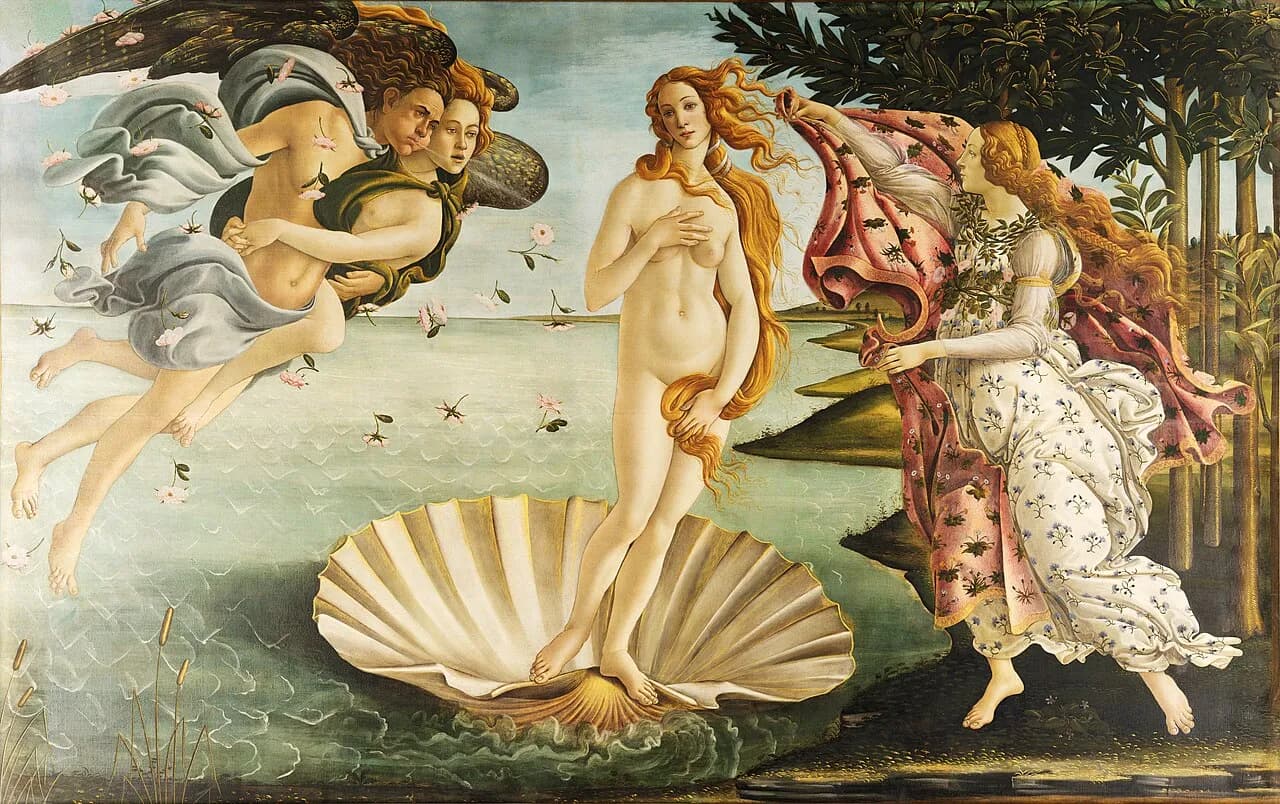
Based on “The Birth of Venus” (c. 1485), Uffizi Gallery, Florence
Botticelli's Venus emerges from the waves — the painting that launched the Renaissance, now for your wall.
Quantity
When Botticelli painted The Birth of Venus around 1485, it was the first time since antiquity that a full-scale painted nude of a pagan goddess had appeared in Western art — a radical act that announced the Renaissance's bold reclamation of the classical world. Commissioned almost certainly by Lorenzo di Pierfrancesco de' Medici, the painting drew on Ovid's Metamorphoses and a contemporary poem by Angelo Poliziano to depict the moment Venus, born fully formed from the sea foam generated by Saturn's severed body, reaches the shore and is draped in a flowering cloak by a Hora, one of the goddesses of the seasons. The Venus who stands at the painting's centre is simultaneously a classical goddess and a quattrocento ideal of feminine beauty, her golden hair swept to one side by the breath of the wind-god Zephyr and his companion. Botticelli's unique genius lies in the painting's ability to suggest both movement and stillness, both the divine and the approachable. Her pose, based on the antique Venus Pudica (the modest Venus), gives her a vulnerability and modesty that humanises the divine figure. The whole composition floats with a lyrical, almost weightless grace that no other Renaissance artist quite achieved. The painting spent centuries in the Medici villas, little known outside Florence, before the Uffizi acquired it. It was the Pre-Raphaelites in the nineteenth century who first made Botticelli an international sensation, finding in his linear, decorative style an antidote to what they saw as the bombastic materialism of academic painting. Today The Birth of Venus is not merely a great painting but a cultural shorthand for beauty itself — referenced, parodied, and reimagined by artists, advertisers, and filmmakers for over a century.
Sandro Botticelli, c. 1485
Read the full story →Giclée print on 310gsm cotton rag archival paper. Archival pigment inks, lightfast for 100+ years under UV glass. Frame with UV-protective glazing for best preservation.