Bharat Mata Fine Art Print
Based on “Bharat Mata” (1905), Rabindra Bharati Society, Kolkata
Abanindranath Tagore's iconic Bharat Mata — the painting that gave a nation its visual identity, now for your home.
Quantity
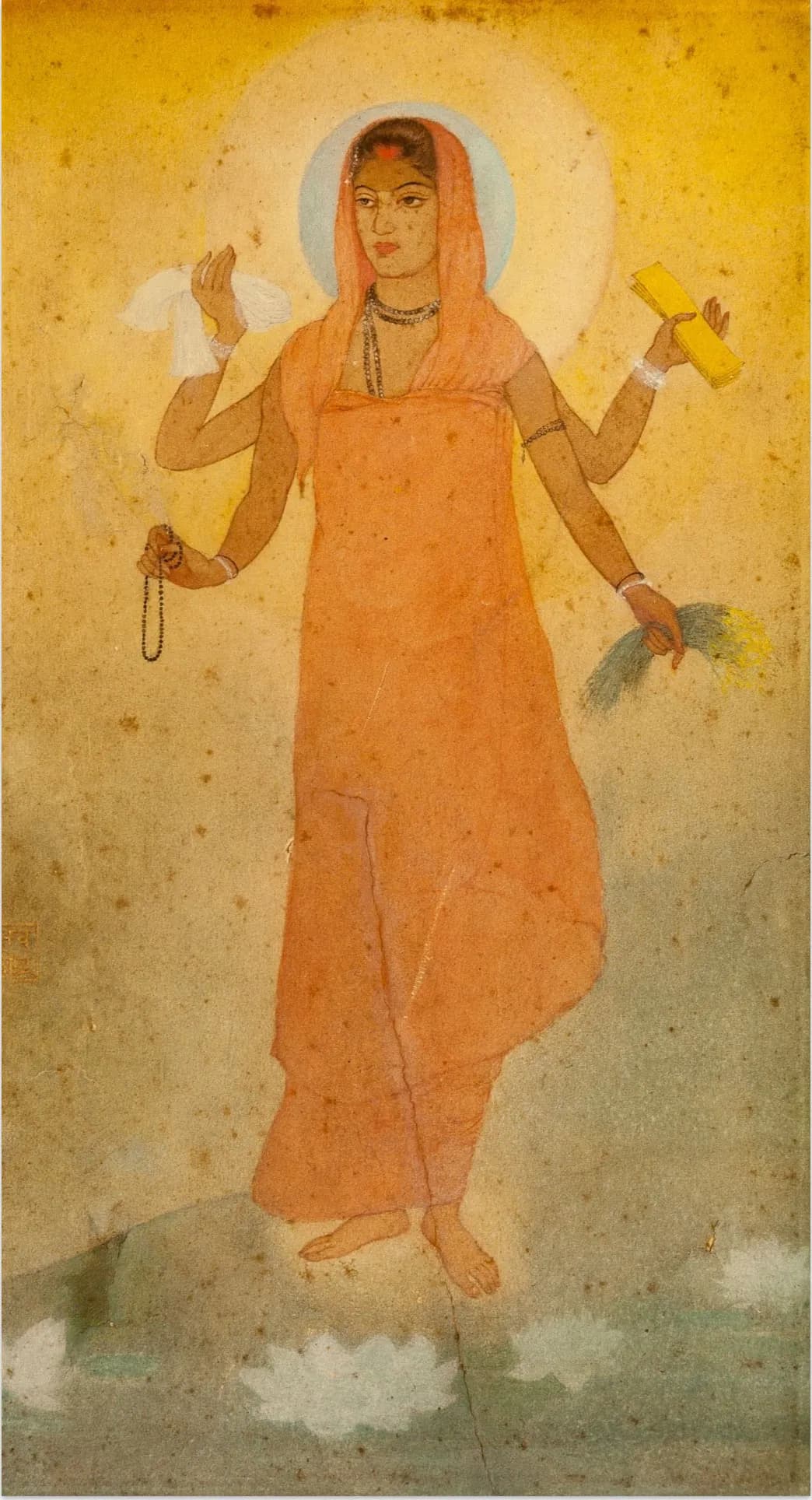
Abanindranath Tagore painted Bharat Mata (Mother India) in 1905 at one of the most charged political moments in Indian history: Lord Curzon's Partition of Bengal, which the nationalist movement saw as a deliberate attempt to divide and weaken Indian resistance to British rule. The painting responded not with anger but with spiritual beauty. A four-armed goddess — simultaneously divine mother, Hindu deity, and personification of India herself — stands robed in saffron, offering sheaves of paddy, a white cloth, a book of learning, and a garland. Her gaze is serene and deeply inward. The image drew simultaneously on the iconography of Hindu goddesses like Durga and Lakshmi and on the luminous, wash-based style that Abanindranath had developed from Mughal miniature painting and Japanese nihonga technique. The result was something new in Indian art: a figure that was recognisably divine but also unmistakably Indian, rendered in a technique that deliberately rejected the European academic oil-painting mode that colonial art institutions championed. It was, in both form and content, an act of cultural decolonisation. Bal Gangadhar Tilak, Aurobindo Ghosh, and eventually Mahatma Gandhi and the broader nationalist movement adopted Bharat Mata as a unifying symbol, and the image circulated in publications, posters, and public pageants throughout the independence struggle. After 1947, it became the visual archetype for countless subsequent representations of India as mother — on currency, in textbooks, in films and political speeches. Few Indian paintings of any period have exercised a comparable political and emotional influence, making Bharat Mata not merely a great work of art but a foundational image of a nation's self-conception.
Abanindranath Tagore, 1905
Read the full story →Giclée print on 310gsm cotton rag archival paper. Archival pigment inks, lightfast for 100+ years under UV glass. Frame with UV-protective glazing for best preservation.