The Story
Bharat Mata
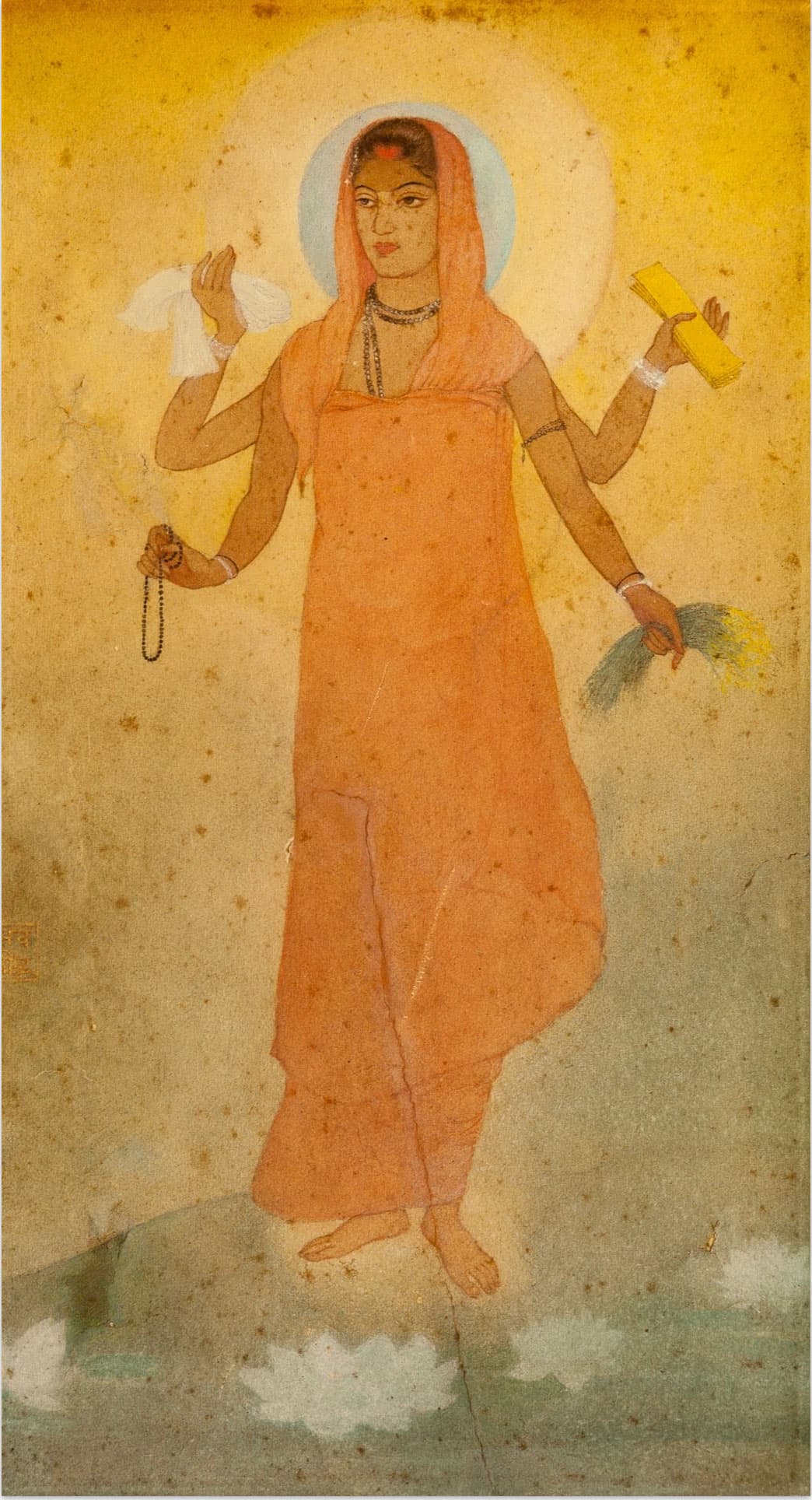
Abanindranath Tagore painted Bharat Mata (Mother India) in 1905 at one of the most charged political moments in Indian history: Lord Curzon's Partition of Bengal, which the nationalist movement saw as a deliberate attempt to divide and weaken Indian resistance to British rule. The painting responded not with anger but with spiritual beauty. A four-armed goddess — simultaneously divine mother, Hindu deity, and personification of India herself — stands robed in saffron, offering sheaves of paddy, a white cloth, a book of learning, and a garland. Her gaze is serene and deeply inward.
The image drew simultaneously on the iconography of Hindu goddesses like Durga and Lakshmi and on the luminous, wash-based style that Abanindranath had developed from Mughal miniature painting and Japanese nihonga technique. The result was something new in Indian art: a figure that was recognisably divine but also unmistakably Indian, rendered in a technique that deliberately rejected the European academic oil-painting mode that colonial art institutions championed. It was, in both form and content, an act of cultural decolonisation.
Bal Gangadhar Tilak, Aurobindo Ghosh, and eventually Mahatma Gandhi and the broader nationalist movement adopted Bharat Mata as a unifying symbol, and the image circulated in publications, posters, and public pageants throughout the independence struggle. After 1947, it became the visual archetype for countless subsequent representations of India as mother — on currency, in textbooks, in films and political speeches. Few Indian paintings of any period have exercised a comparable political and emotional influence, making Bharat Mata not merely a great work of art but a foundational image of a nation's self-conception.
Deep Dive
Scholarly Analysis
Composition & Technique
Abanindranath Tagore painted Bharat Mata in 1905 in a style he had developed in deliberate reaction against Ravi Varma's European academic approach. Drawing on Mughal miniature painting, Rajput folk traditions, and Japanese wash techniques absorbed through contact with the Japanese artists Okakura Tenshin and Yokoyama Taikan, he created a figure of extraordinary iconic simplicity. The four-armed goddess figure — an attribute drawn from Hindu iconography — holds a book, sheaves of rice, a garland of flowers, and a white cloth (alternatively interpreted as representing learning, food, beauty, and cloth or freedom): the four things a liberated India would offer her children. The colour is delicate, the outline defining rather than modelling, the background a simple wash. The figure is simultaneously a Hindu goddess and a political programme.
“In Bharat Mata, Abanindranath achieved what no political pamphlet could: he gave the idea of India a face, and that face looked back at a colonised people and said, quietly, that freedom was not only possible but beautiful.”
Historical Context
The painting was made in 1905, the same year as the Partition of Bengal — Lord Curzon's administrative division of the Bengal Presidency, which was widely experienced by Indian nationalists as a deliberate attempt to fracture Hindu-Muslim solidarity and weaken the independence movement. The Swadeshi movement — the campaign for Indian self-reliance through boycott of British goods — was launched in direct response. Abanindranath, a nephew of Rabindranath Tagore and a central figure in the Bengal Renaissance, painted Bharat Mata as an explicit contribution to this political moment. The figure was reproduced and circulated widely in nationalist publications. It gave the abstract idea of 'Mother India' — Bharat Mata — a specific visual form that became iconic.
“The Bengal partition of 1905 was experienced as an act of violence against the body of India herself — and Abanindranath responded by painting that body, serene, nurturing, and unbroken.”
Cultural Significance
The image of Bharat Mata that Abanindranath established became the template for an entire iconographic tradition that continues to the present day. The four-armed goddess as nation is reproduced in political imagery, temple murals, and popular prints throughout India. The painting also represents one of the first moments in modern Indian art history where visual form and political consciousness are explicitly and self-consciously unified — where an Indian artist creates an Indian image for Indian purposes, using a visual vocabulary drawn from Indian tradition rather than European convention.
“Abanindranath understood that India needed to see herself before she could become herself — that the visual imagination of nationhood was inseparable from its political realisation.”
“This small picture made a large India. Perhaps no other painting in the history of Indian art has had so direct a consequence in the world outside the frame.”
Critical Reception
The painting was immediately understood as a political act and received as such — praised by nationalist intellectuals, discussed in Swadeshi publications, and circulated in reproduction. Critical art historical reception came later, as the Bengal School style that Abanindranath championed fell out of critical favour in the mid-twentieth century and was reassessed in postcolonial scholarship from the 1980s onward. Today it is held in the Victoria Memorial collection in Kolkata and is considered one of the foundational documents of modern Indian art.
“The Bengal School made the mistake of thinking that the authenticity of its visual language was inseparable from its nationalism. Later critics made the equal and opposite mistake of separating them entirely. The truth of Bharat Mata requires both.”
About the Artist
The Artist
Abanindranath Tagore
Indian · Bengal School
Abanindranath Tagore (1871–1951), nephew of Nobel laureate Rabindranath Tagore, was the founding figure of the Bengal School of Art, a movement that consciously sought to develop a distinctly Indian modernism rooted in Mughal miniature painting, Japanese wash techniques, and indigenous craft traditions. Rejecting the European academic style that dominated Indian art schools, he championed a lyrical, spiritually charged aesthetic that became the visual language of the Indian independence movement. His Bharat Mata, painted during the Partition of Bengal in 1905, remains one of the most politically and emotionally powerful images in Indian art history.
Own a Piece of This Masterpiece
Bring Bharat Mata Into Your World
Museum-quality reproductions and artisan objects inspired by this masterwork — scarves, mugs, prints, and more. Crafted with the care the original deserves.