The Story
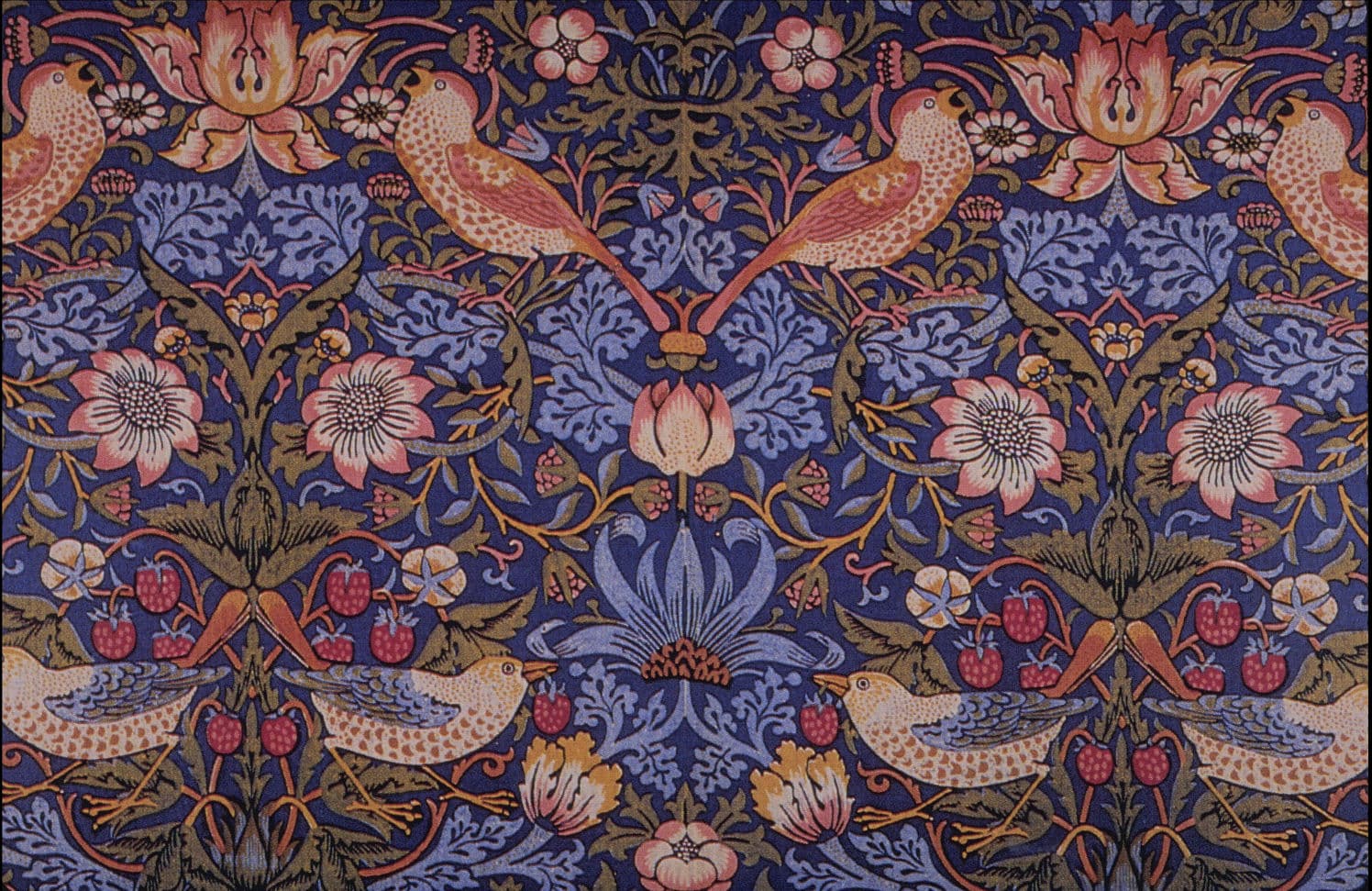
Strawberry Thief
The story behind Strawberry Thief is as English as a kitchen garden on a June morning. Morris had noticed thrushes raiding the strawberry beds at his beloved Kelmscott Manor in Oxfordshire, and in 1883 he translated this domestic observation into what would become his most celebrated textile design. The pattern shows pairs of indigo-blue thrushes caught mid-theft among a dense, jewel-like tangle of strawberry plants, acanthus leaves, and flowering stems — a world teeming with life, colour, and the quiet comedy of a bird getting away with something it shouldn't.
The technical achievement was considerable. To achieve the indigo blues and rich reds that Morris demanded, he revived the medieval indigo-discharge dyeing process — a laborious technique requiring many separate printings and precise timing that most commercial manufacturers had abandoned as too costly. Morris insisted on it because it produced the depth and richness of colour that chemical dyes could not match. The finished textile, block-printed at his Merton Abbey Mills workshop, was expensive by the standards of the day. Morris was famously frustrated that his handcraft ideals remained available mainly to the wealthy class he despised, but the quality he achieved was undeniable.
Today Strawberry Thief is in its second century of continuous production, still printed from designs derived from Morris's original blocks, still available from Liberty of London, still reproduced on wallpapers, cushions, ceramics, and fashion accessories worldwide. It has outlasted the historical moment that produced it, the political movement that inspired it, and virtually every trend in design since 1883. It endures because it captures something permanent: the pleasure of a summer garden, the comedy of small creatures, and the conviction that the surfaces of everyday life deserve to be beautiful.
Deep Dive
Scholarly Analysis
Composition & Technique
William Morris designed Strawberry Thief in 1883 using the traditional indigo discharge printing technique — a process so technically demanding that it was the only design Morris printed at Merton Abbey using this method. The pattern required the ground to be dyed in weft using indigo, and the lighter areas achieved by discharging (bleaching) the colour and re-dyeing. The registration of multiple blocks to achieve this was extraordinarily complex. The design itself operates on the classic Morris principle of symmetrical but non-mechanical repetition: thrushes steal strawberries amid a dense, rhythmically interlocking ground of acanthus leaf, willow, and fruit. The eye traces a path that never arrives at a resting point — the pattern contains its own infinite continuation. The colour palette — the famous combination of indigo, madder red, and gold — was achieved with vegetable dyes rather than the synthetic aniline dyes Morris despised.
“Morris's patterns do not decorate a surface — they ARE the surface. There is no substrate and no ornament, only structure. This is the deepest thing Ruskin taught him.”
Historical Context
Strawberry Thief was designed in the same year that the Fabian Society was founded, and Morris's Arts and Crafts philosophy was inseparable from his socialism. His central argument — that industrial capitalism had degraded labour and destroyed the meaningful relationship between the maker and the made thing — positioned his textiles as political objects as much as aesthetic ones. The strawberry thieves that give the pattern its name were the real thrushes in Morris's garden at Kelmscott Manor, which he caught stealing his fruit with exasperated affection. The pattern was an enormous commercial success and became one of the defining images of the Arts and Crafts movement, eventually turning the very capitalism Morris opposed into its distributor.
“Morris wanted to make beautiful things available to everyone. The paradox is that his beautiful things became available only to those who could afford them — which was not everyone.”
Cultural Significance
The Arts and Crafts movement that Morris catalysed had a global reach that transformed interior design, typography, architecture, and the philosophy of making across three continents. Frank Lloyd Wright absorbed its principles; the Bauhaus was in direct conversation with it; the contemporary maker movement and artisan revival of the twenty-first century are its distant descendants. Strawberry Thief specifically has become one of the most instantly recognisable patterns in English design history, reproduced and licensed globally and held in the permanent collections of museums from the V&A to the Metropolitan Museum. It is one of the few decorative art objects to have crossed fully into the category of icon.
“Strawberry Thief is the most English of all English patterns — not because it depicts England, but because it embodies a particular English fantasy about the relationship between nature and human artifice: intimate, seasonal, slightly melancholy.”
“The genius of Morris's pattern-making is that it never repeats twice in the same way for the eye, only for the loom. The organic logic of growth disguises the mechanical fact of manufacture.”
Critical Reception
Contemporary critics in the 1880s admired Strawberry Thief's technical achievement more than its aesthetic impact — the indigo discharge process was genuinely novel, and Morris's willingness to maintain traditional dyeing methods against cheaper synthetic alternatives was noted as a principled stand. The twentieth century reassessed the whole Morris project through successive critical lenses: the Arts and Crafts revival of the 1970s, the postmodern interrogation of ornament and authenticity, and most recently the reassertion of craft and making as ethical practices in response to fast fashion and mass production. Strawberry Thief sits at the centre of all these conversations.
“Morris invented the idea that domestic objects could carry ethical weight — that choosing your wallpaper was a moral act. We are still living in the world that argument created.”
About the Artist
The Artist
William Morris
British · Arts & Crafts Movement
William Morris (1834–1896) was a British textile designer, poet, novelist, and socialist activist who almost single-handedly launched the Arts and Crafts Movement as a protest against the dehumanising effects of industrial mass production. Inspired by medieval craftsmanship and natural forms, he founded Morris & Co. in 1861 and went on to design some of the most beloved wallpapers and textiles in design history, from Willow Bough to Strawberry Thief. His conviction that beautiful, well-made objects should be available to everyone, not merely the wealthy, anticipated the design philosophies of the Bauhaus and the broader modern design movement.
Own a Piece of This Masterpiece
Bring Strawberry Thief Into Your World
Museum-quality reproductions and artisan objects inspired by this masterwork — scarves, mugs, prints, and more. Crafted with the care the original deserves.