The Story
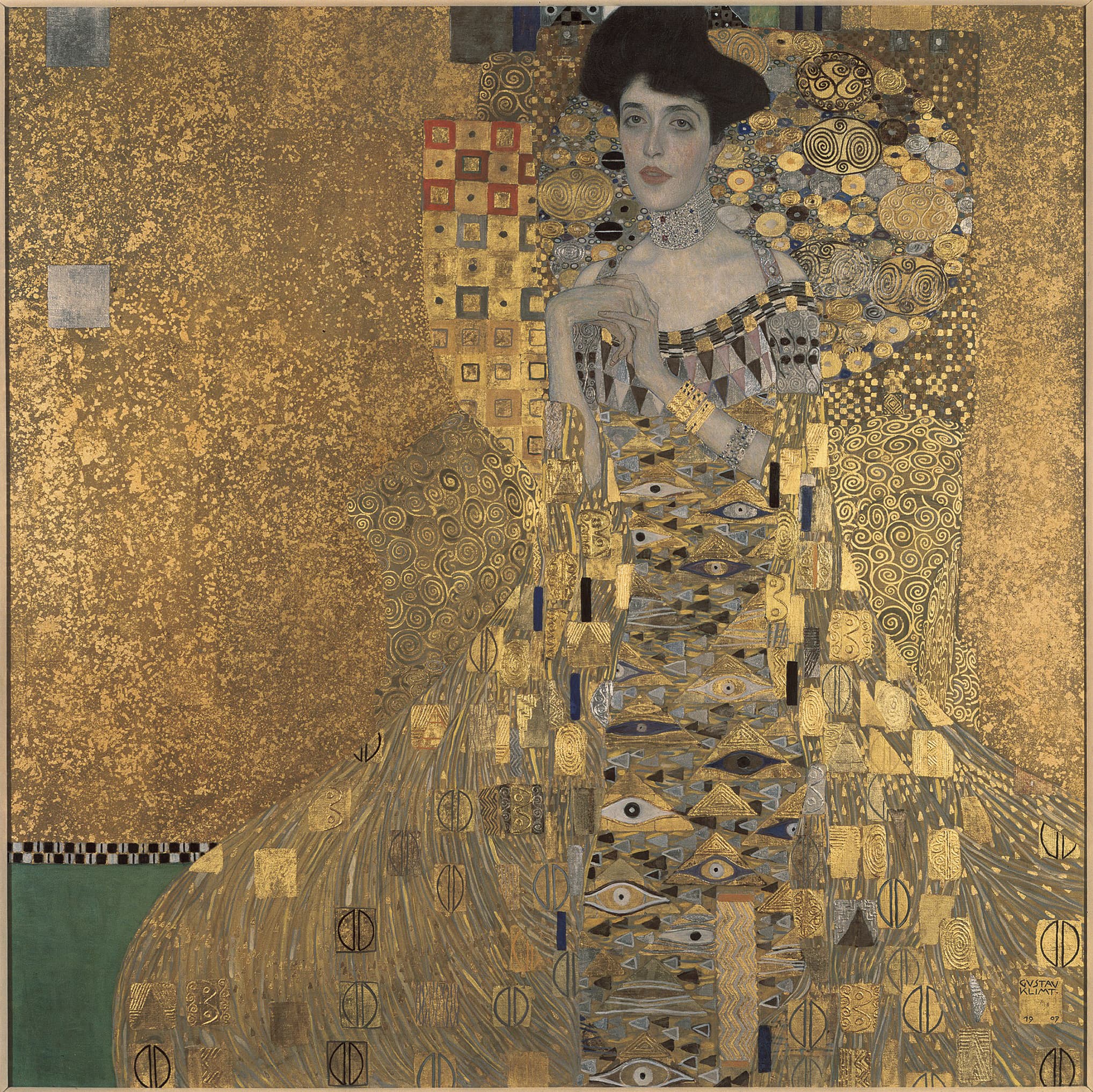
Portrait of Adele Bloch-Bauer I
Klimt spent four years preparing and painting the portrait of Adele Bloch-Bauer, wife of Ferdinand Bloch-Bauer, a wealthy Jewish sugar magnate and art patron who was among Klimt's most important supporters. He made over 100 preparatory sketches — more than for any other work in his career — and the finished canvas, completed in 1907, is the apotheosis of his Golden Period: Adele's face and hands emerge from a shimmering field of gold leaf decorated with abstract Byzantine patterns, Egyptian eyes, spiral motifs, and delicate silver accents. She is simultaneously a specific woman and an icon, human and divine.
The painting's twentieth-century history is as dramatic as any thriller. When the Nazis annexed Austria in 1938, they seized the Bloch-Bauer family's art collection, including four Klimts, and eventually hung the portrait in the Belvedere Museum, calling it simply "Woman in Gold" to erase its Jewish provenance. For decades it was considered Austria's Mona Lisa. After the war, Adele's niece Maria Altmann spent years in legal battle to recover the works her aunt had explicitly requested be given to the Belvedere after her death but which had been seized, not bequeathed. In 2006, an international arbitration panel awarded the paintings to Altmann, and the Woman in Gold sold to Ronald Lauder's Neue Galerie in New York for $135 million, at the time the highest price ever paid for a painting.
The story was told in the 2015 film Woman in Gold with Helen Mirren. But the painting itself transcends its remarkable history: stand before it and you are simply overwhelmed by the breathtaking ambition of a man who decided to wrap a human being in the radiance of the divine.
Deep Dive
Scholarly Analysis
Composition & Technique
Portrait of Adele Bloch-Bauer I (1907) represents the apotheosis of Klimt's Golden Phase — the most extravagant and technically complex realisation of his synthesis of Byzantine gold-ground painting with Jugendstil ornament. The figure of Adele is almost entirely dissolved into the decorative field: her face and hands — the only passages of conventional flesh-toned representational painting — emerge from a ground of gold-leaf application so dense and varied in texture that it requires a lengthy examination to disentangle the figure from the ornamental field. The chair, the background, and the dress are unified into a single field of patterned gold interrupted by eye-forms (Klimt's persistent motif), spirals, and geometric units borrowed from Byzantine mosaics and Egyptian art. The work took three years to complete and required hundreds of preparatory drawings.
“Adele is barely there — almost absorbed by her own portrait. Klimt turned his subject into a goddess and an icon simultaneously, which is perhaps what she wanted and what he needed.”
Historical Context
Ferdinand Bloch-Bauer, a wealthy Viennese sugar merchant and patron of the arts, commissioned the portrait of his wife Adele. The Bloch-Bauers were part of the assimilated Jewish bourgeoisie of Vienna that formed the backbone of its cultural life before the Nazi annexation. After the Anschluss of 1938, the portrait — along with four other Klimt works — was seized by the Nazi regime. Adele, who died in 1925, had expressed a wish that the paintings be donated to the Austrian state, but Ferdinand fled Austria and died in exile in 1945 without being able to reclaim his property. After decades of legal battle, his niece Maria Altmann successfully reclaimed all five paintings from the Austrian government in 2006. The portrait sold at auction for $135 million — then a world record for a painting.
“The portrait is inseparable from the catastrophe that befell the people who owned it. It is at once a magnificent object and a document of loss.”
Cultural Significance
The restitution of the Bloch-Bauer portrait in 2006 and its acquisition by the Neue Galerie in New York made it one of the most publicly discussed artworks of the twenty-first century. The film 'Woman in Gold' (2015) brought the story to global audiences. The painting is now inseparable from the history of Nazi looting, the struggle for cultural restitution, and the specific tragedy of Viennese Jewish culture — a culture that produced Freud, Wittgenstein, Mahler, Schönberg, and Klimt, and was destroyed within a decade. The portrait has become, in this way, more than a Klimt — it is a memorial.
“She is the 'Woman in Gold,' but she is also a ghost — the ghost of an entire world that was taken, as she was taken, and that we can only partly recover.”
“Klimt made Adele a goddess. History made her a symbol of something else entirely — of what can be lost when civilization fails itself.”
Critical Reception
The portrait was exhibited in 1907 and received as a masterwork of the Golden Phase. Critical commentary in Klimt's lifetime focused on the extraordinary technical achievement of the gold-work and the ambiguity of the figure within the decorative field. Post-restitution critical writing has inevitably addressed the painting's provenance alongside its aesthetics. The art historian Alfred Weidinger's catalogue raisonné of Klimt's work (2007) provided the definitive scholarly account of the painting's genesis. Commercial appraisal — reflected in its record auction price — placed it in the company of the world's most financially valued artworks.
“Klimt gave Adele what few portrait painters have given their subjects — the quality of myth. She becomes more than herself in his hands. Whether that is a tribute or a reduction depends on your view of the relationship between art and the person it depicts.”
About the Artist
The Artist
Gustav Klimt
Austrian · Art Nouveau / Symbolism
Gustav Klimt (1862–1918) was the foremost figure of the Vienna Secession, an artistic movement that broke decisively from academic tradition in favour of a sensuous, ornamental aesthetic. His canvases are instantly recognisable for their lavish use of gold leaf, Byzantine patterns, and erotically charged symbolism that blurred the boundary between fine art and decorative craft. Works like The Kiss and the Portrait of Adele Bloch-Bauer I remain among the most commercially valuable and culturally resonant paintings in the world.
Own a Piece of This Masterpiece
Bring Portrait of Adele Bloch-Bauer I Into Your World
Museum-quality reproductions and artisan objects inspired by this masterwork — scarves, mugs, prints, and more. Crafted with the care the original deserves.