Red Fuji Ceramic Mug
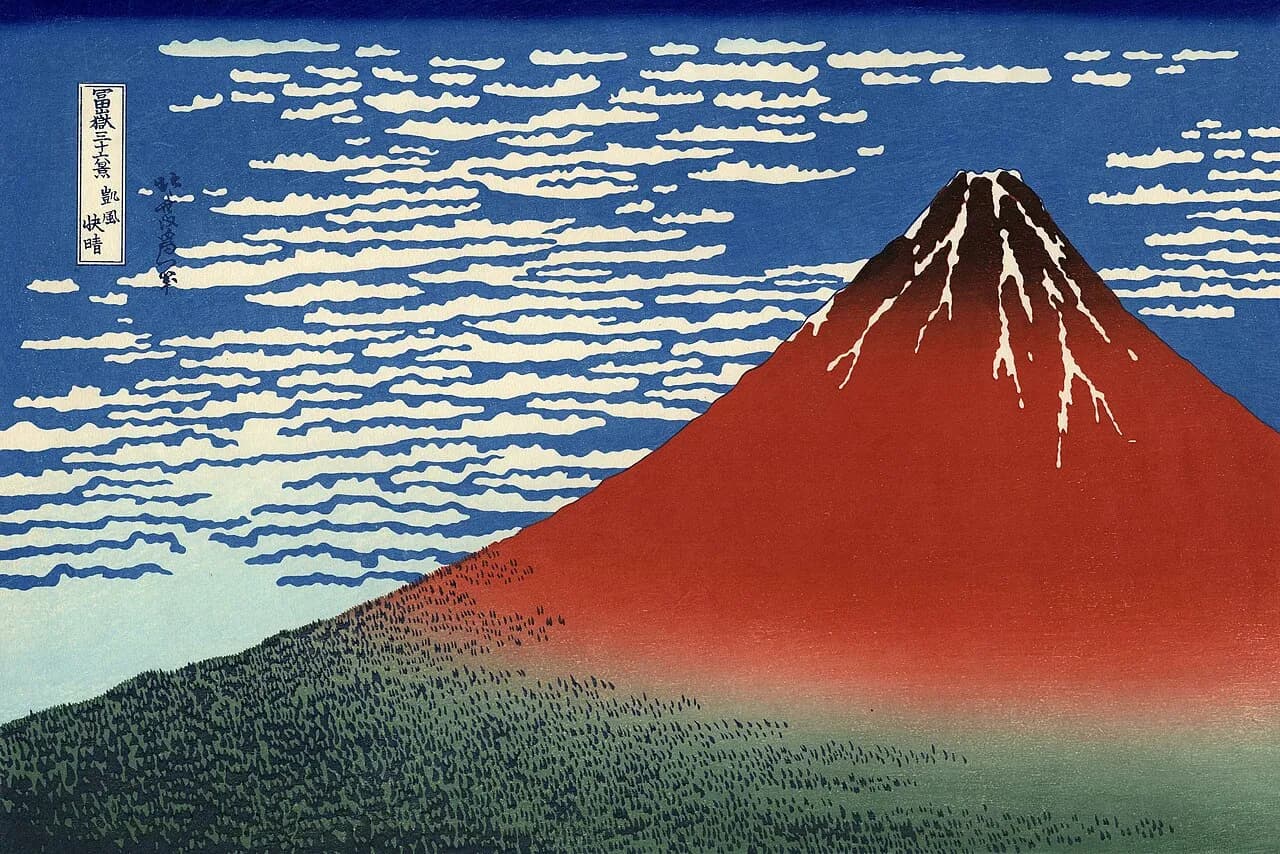
Based on “Red Fuji (Fine Wind, Clear Morning)” (c. 1831), Various public collections
Hokusai's serene mountain in morning red — start your day with Japan's most sacred peak.
Quantity
If The Great Wave is Hokusai at his most dramatic, Red Fuji is Hokusai at his most meditative — and many argue it is the greater achievement. The print, from the same Thirty-six Views of Mount Fuji series of around 1831, shows the mountain alone against a sky of deep blue gradating to pale grey, its snow-dusted summit glowing an improbable deep red-orange in the light of early summer morning. Three small clouds drift across the lower slopes. The horizon is a single, clean line. Nothing else competes for attention. The composition is an exercise in radical simplicity that borders on abstraction. Hokusai divides the image into three horizontal bands — sky, mountain, forest — and uses only a handful of colours, yet achieves a sense of monumental presence that no amount of detail could improve. The red of the mountain, which Fuji assumes on certain late-summer mornings when wind and angle of light conspire, was considered by the Japanese of the period to be an auspicious omen, a sign of the mountain's sacred power made visible. Hokusai gives us not just a landscape but a spiritual experience of place. This print was a particular favourite of the Impressionists and Post-Impressionists who encountered it through the Japonisme craze, and its influence can be traced in the flat colour fields of Gauguin, the simplified compositions of Cézanne, and the decorative audacity of Art Nouveau. Its lesson — that restraint is not poverty but discipline, that emptiness can be the most powerful element of a composition — is one that every great designer since has had to learn, and many have learned it from Hokusai.
Katsushika Hokusai, c. 1831
Read the full story →High-fired ceramic with scratch-resistant glaze. Dishwasher and microwave safe. Hand washing recommended to preserve print vibrancy over time.