The Story
Water Lilies
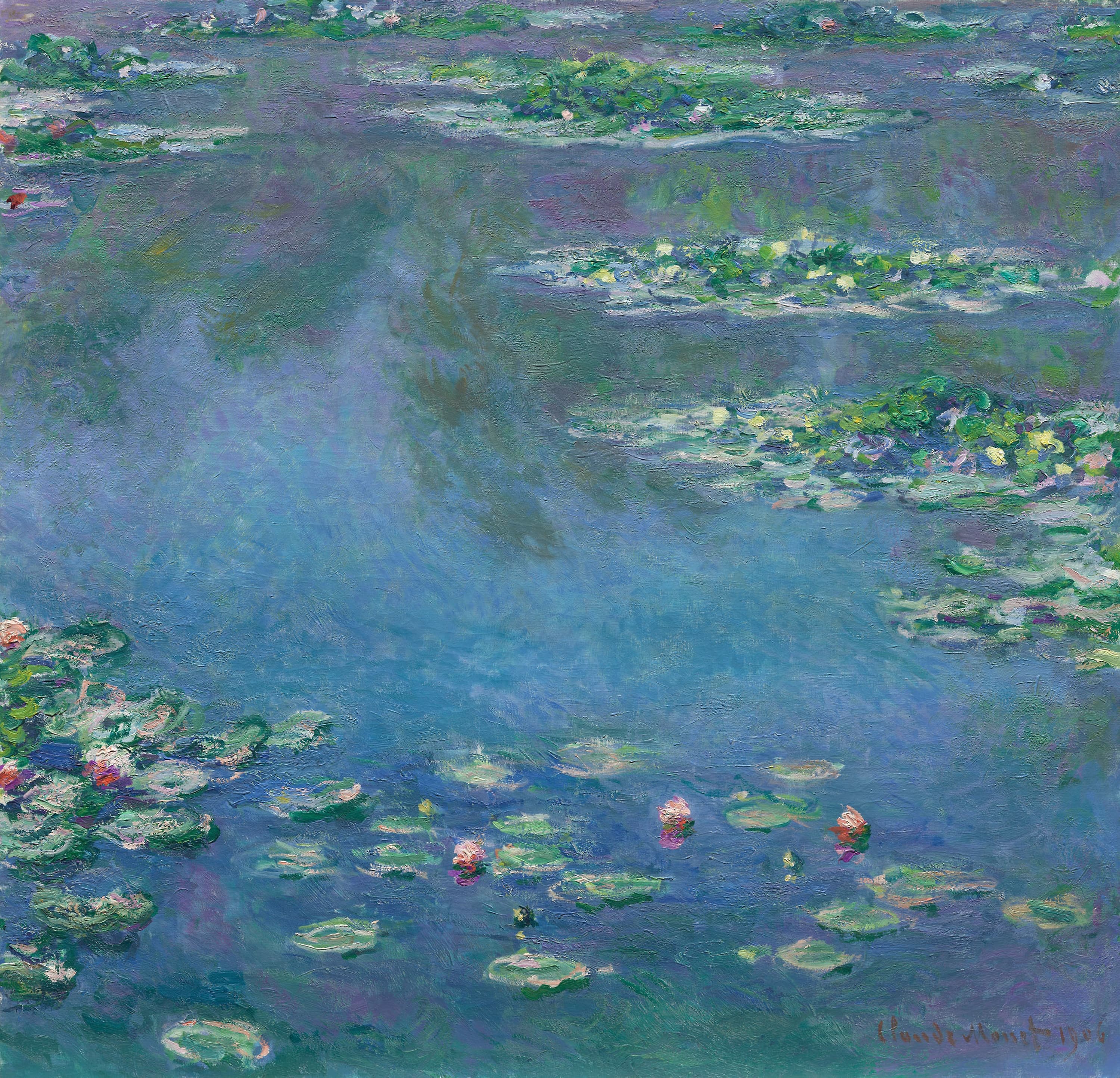
In 1893 Claude Monet purchased a plot of land adjacent to his property in Giverny, diverted a local stream, and began constructing the water garden that would consume the last three decades of his life. What started as a hobby became an obsession: over the years he added the Japanese footbridge, the weeping willows, the wisteria pergola, and — most importantly — the water lily pond whose surface became his ultimate subject. By 1906, when this canvas was completed, he had been studying the pond for over a decade and had reached a level of mastery that allowed him to abandon the sky and horizon entirely.
The 1906 Water Lilies marks a crucial turning point in the series. Without a horizon line, without trees or banks to anchor the composition, the viewer is adrift on pure surface: green and violet lily pads float on water that reflects clouds and sky, creating a vertiginous ambiguity between above and below. Is this the pond's surface or its depth? Monet was not painting water lilies at all — he was painting light as it moved through water, atmosphere, time of day, and the seasons. The subject was perception itself.
As his cataracts worsened in the 1910s and early 1920s, Monet's palette grew increasingly red and orange, the forms increasingly dissolved. What had begun as close observation became pure abstraction driven by felt colour rather than seen form. The American Abstract Expressionists who encountered the late Nymphéas panels after the Second World War — particularly Mark Rothko and Jackson Pollock — recognised in them a precursor to their own work. Monet, the Impressionist, had painted his way to the threshold of Abstract Expressionism forty years before the movement had a name.
About the Artist
The Artist
Claude Monet
French · Impressionism
Claude Monet (1840–1926) was the founding father of French Impressionism, a movement he helped name — albeit inadvertently — with his painting Impression, Sunrise. Obsessed with capturing the transient qualities of natural light at different times of day and seasons, he returned to the same subjects again and again, painting his garden at Giverny with an almost scientific dedication to observation. His late Water Lilies series, painted as his eyesight was failing, pushed colour and abstraction to boundaries that would inspire generations of modernists.
Own a Piece of This Masterpiece
Bring Water Lilies Into Your World
Museum-quality reproductions and artisan objects inspired by this masterwork — scarves, mugs, prints, and more. Crafted with the care the original deserves.