The Story
Shakuntala
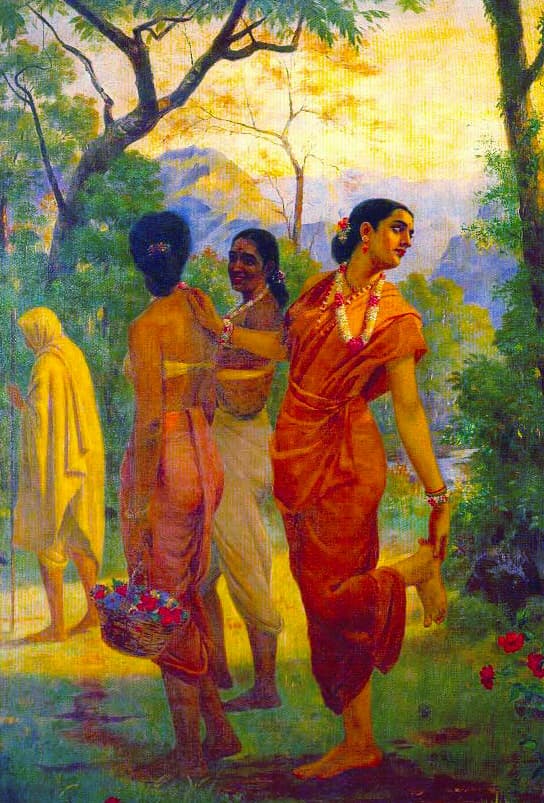
In Kalidasa's fourth-century Sanskrit play Abhijnanashakuntalam, the young Shakuntala pauses by a forest pool to remove a thorn from her foot, distracted by her love for King Dushyanta. It is this moment of tender distraction that Ravi Varma chose for his breakthrough painting of 1870: the heroine glances backward over her shoulder, her body language caught between self-consciousness and longing. The choice of subject was brilliant. It gave Varma the opportunity to demonstrate his European-trained command of anatomy, fabric, and foliage while remaining firmly rooted in the world of Indian literary mythology.
The painting was the first to win Varma a major prize at an exhibition — the Madras Art Exhibition of 1876 — and it announced to both Indian and British audiences that an Indian painter had fully mastered the academic oil-painting tradition without abandoning his own cultural heritage. The challenge Varma had set himself was immense: to paint Hindu gods and mythological figures convincingly, he had to invent a visual language, since there was no Indian precedent for this combination of devotional subject matter and Western naturalistic technique. Shakuntala solved that problem, demonstrating that a woman from Kalidasa's forest could be rendered with the same fidelity to observed human beauty as any figure from a European mythology.
The painting's influence was amplified enormously by Varma's later decision to print oleograph reproductions of his mythological paintings, distributing them at low cost across the subcontinent. These prints entered millions of homes and temples, defining what Indian gods and goddesses "looked like" for generations. The visual grammar Varma established in works like Shakuntala shaped Indian popular religious imagery throughout the twentieth century and continues to do so today.
About the Artist
The Artist
Raja Ravi Varma
Indian · Modern Indian Art
Raja Ravi Varma (1848–1906) was the first Indian painter to master European academic oil-painting techniques and apply them to scenes drawn from Hindu mythology and Indian everyday life, creating a new visual language that resonated across the subcontinent. His large-format canvases brought gods, goddesses, and epic heroes to life with a naturalistic warmth that made them immediately accessible to ordinary Indians, and his oleograph prints disseminated these images into millions of homes. Often called the Father of Modern Indian Art, his legacy extends from the walls of palaces to the shrines of humble households.
Own a Piece of This Masterpiece
Bring Shakuntala Into Your World
Museum-quality reproductions and artisan objects inspired by this masterwork — scarves, mugs, prints, and more. Crafted with the care the original deserves.